

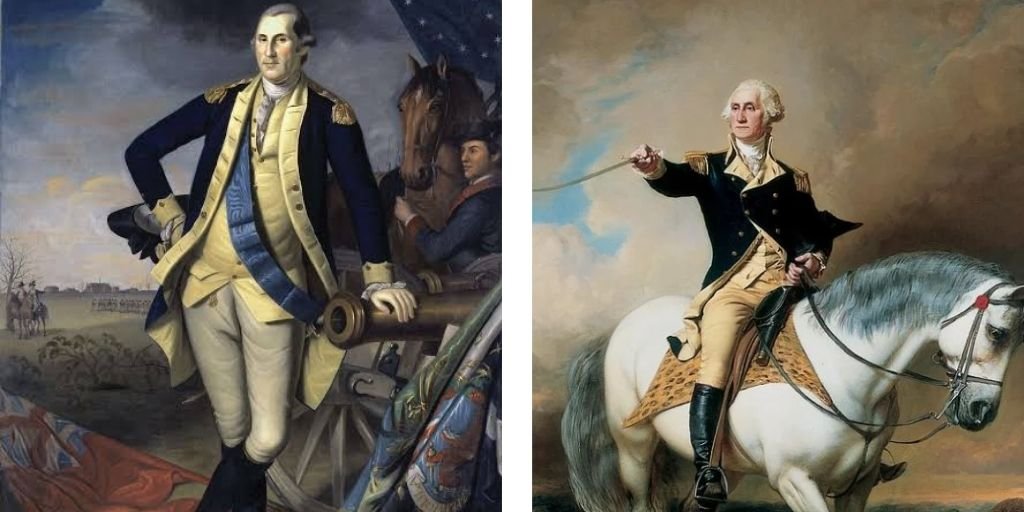
George Washington is one of the most recognizable names in American history. He was a military commander, plantation owner, political leader, president, and an important figure in the creation of the United States. Yet his life was much more complicated than the familiar image of the man standing at the center of a famous portrait.
Born in Virginia in 1732, Washington lived during a period of enormous change. The American colonies were part of the British Empire when he was young. By the time he died in 1799, the United States had fought a revolution, adopted a Constitution, created a federal government, and established the presidency.
What made his life remarkable was not simply the number of important positions he held. Washington repeatedly found himself in situations where the future of the new country was uncertain. His choices during the Revolutionary War, Constitutional Convention, and presidency helped shape institutions that continued after his lifetime.
At the same time, understanding Washington requires looking at the whole person, including his wealth, political beliefs, military career, and ownership of enslaved people. His legacy therefore contains both achievements that shaped the country and historical realities that remain deeply important to understand.
Early Life and Family Background
Birth and childhood
George Washington was born on February 22, 1732, at Popes Creek in Westmoreland County, Virginia. His parents were Augustine Washington and Mary Ball Washington. He was the eldest of their six children. The Washington family belonged to Virginia’s landed gentry and lived within a society where agriculture, land ownership, and social position were closely connected.
Washington’s childhood changed significantly when his father died in 1743. George was only eleven years old. His older half-brother Lawrence became an important influence in his life and helped introduce him to opportunities involving land, military service, and Virginia’s upper social circles.
Washington did not receive the kind of formal education that some wealthy young men of his generation received. Instead, he developed practical skills. Mathematics, writing, geography, and surveying became especially useful to him.
Learning through surveying
At sixteen, Washington joined a surveying expedition into Virginia’s Shenandoah Valley. Surveying was more than a way to earn money. It gave him firsthand knowledge of land, rivers, roads, mountains, and frontier settlements.
That experience later became valuable during his military career. Think of it as learning the map before being asked to play the game. Washington developed an understanding of terrain that could help him make decisions in difficult military situations.
George Washington and the French and Indian War
Washington’s military story began long before the American Revolution.
In the early 1750s, Britain and France were competing for control and influence in North America. Washington became involved in the conflict while still a young officer. In 1754, he led Virginia troops into the Ohio Valley and took part in the fighting that helped trigger the wider French and Indian War.
His defeat at Fort Necessity was not a great military victory, but the experience mattered. Washington gained firsthand knowledge of warfare, leadership, logistics, and the difficulties of commanding troops on the frontier.
The conflict also gave him a reputation beyond Virginia. He learned from mistakes and gradually became a more experienced officer.
From young officer to experienced leader
Military service exposed Washington to a world very different from plantation life. He learned about discipline, command structures, supply problems, and the importance of geography.
These lessons would become particularly important two decades later when he was asked to command the Continental Army. At that point, however, he was still a young Virginian trying to establish his position in colonial society.
Marriage, Mount Vernon, and Life as a Planter
In January 1759, Washington married Martha Dandridge Custis, a wealthy widow. The marriage connected him to significant property and social networks in Virginia. The couple had no children together, but Washington helped raise Martha’s children and later grandchildren.
Washington eventually became closely associated with Mount Vernon, his estate along the Potomac River. There he managed agricultural operations, land, finances, correspondence, and numerous other responsibilities.
Life at Mount Vernon
Mount Vernon was not simply a comfortable home. It was a working plantation that depended heavily on enslaved labor. Hundreds of enslaved men, women, and children lived and worked there at different points during Washington’s lifetime. In 1799, 317 enslaved people were associated with Mount Vernon: 123 were owned directly by Washington, 153 belonged to the Custis estate, and 41 were rented from other owners.
This part of Washington’s life is essential to understanding him accurately. He participated in a system of slavery throughout much of his adult life even as his views gradually changed.
After the Revolutionary War, Washington increasingly expressed uneasiness about slavery. However, he did not become a public abolitionist leader. His eventual decision regarding the people he directly owned appeared in his 1799 will.
Washington and the American Revolution
The American Revolution transformed Washington’s life.
By the 1770s, tensions between Britain and the American colonies had become increasingly serious. Washington had already served in the colonial legislature and participated in the Continental Congress. When armed conflict began in 1775, the Continental Congress selected him as commander in chief of the Continental Army.
Washington accepted a responsibility that would keep him away from Mount Vernon for years.
The challenge of commanding the Continental Army
The Continental Army faced enormous difficulties. Soldiers lacked adequate supplies, money was limited, enlistments expired, and maintaining a large army was extremely difficult.
Washington was not an unbeatable battlefield commander. Historians have debated his military abilities for generations. What is clearer is that he played an important role in keeping the American army functioning through extremely difficult periods.
His leadership was particularly important during the winter of 1776–1777.
On December 26, 1776, Washington’s forces crossed the Delaware River and attacked the Hessian garrison at Trenton. The victory was followed by another success at Princeton on January 3, 1777. These victories helped restore American morale at a dangerous point in the war.
Yorktown and the end of major fighting
The war continued for several more years. Washington worked with American and French forces as the conflict developed.
In 1781, American and French forces surrounded the British army commanded by General Charles Cornwallis at Yorktown, Virginia. The British surrender became a decisive moment in the struggle for American independence.
Washington’s military career had reached its defining stage. Yet perhaps one of his most important decisions came after the fighting.
Rather than attempting to become a permanent military ruler, Washington returned to Mount Vernon. He had commanded an army, but he did not seek to turn military power into personal political power.
The Constitutional Convention of 1787
After independence, the new United States faced serious political and economic problems. The Articles of Confederation had created a national government with limited powers. Disagreements among states and problems involving taxation, commerce, territory, and national finances contributed to growing concerns about the country’s future.
Washington became increasingly interested in strengthening the national government.
In 1787, delegates gathered in Philadelphia for the Constitutional Convention. Washington was unanimously selected to preside over the convention.
A symbolic and practical role
Washington did not dominate the convention’s debates in the same way that some delegates did. His presence nevertheless carried enormous symbolic importance.
The National Archives notes that his leadership helped give the convention legitimacy. He also signed the Constitution first. Thirty-nine delegates ultimately signed the document on September 17, 1787.
The Constitution created a new federal structure, including an executive branch headed by a president.
Washington would soon become the first person to occupy that office.
Becoming the First President of the United States
The presidential office was an experiment. Nobody could simply look at an established tradition and copy it.
Washington was elected in 1789 and received all 69 electoral votes cast. On April 30, 1789, he took the presidential oath at Federal Hall in New York City.
Building the presidency from the ground up
Washington had to help determine what the presidency should actually look like.
How should the president communicate with Congress? How formal should presidential ceremonies be? What role should advisors play? How should the executive branch deal with foreign governments? What relationship should exist between the president and the states?
There were no long-established answers.
Washington therefore became a model for future presidents in many ways. His administration helped establish customs and practices surrounding the new office.
His first inaugural address reflected the seriousness of the moment. He described himself as walking on “untrodden ground,” recognizing that the country was creating something without a clear historical template.
Washington’s Presidency and Major Challenges
Washington served from 1789 to 1797. His administration faced difficult domestic and international questions.
Creating a functioning federal government
The new government needed revenue, administrative departments, courts, and systems for handling national responsibilities. Washington worked with figures such as Alexander Hamilton and Thomas Jefferson, whose political disagreements became increasingly significant.
The administration also faced the challenge of establishing federal authority while respecting the constitutional structure.
One major test came during the Whiskey Rebellion. Opposition to a federal excise tax on distilled spirits developed into resistance in western Pennsylvania. Washington eventually led federal forces to demonstrate that the new government had the authority to enforce federal law.
Foreign affairs and neutrality
International politics created another major challenge.
The French Revolution and the subsequent European wars placed pressure on the United States. Many Americans sympathized with France, while others feared that involvement in European conflicts could threaten the young republic.
Washington’s administration adopted a policy of neutrality. His government also negotiated the controversial Jay Treaty with Britain.
These decisions generated fierce political disagreement, helping reveal the growing divide between emerging Federalist and Democratic-Republican political factions.
Washington personally disliked partisan conflict, but political parties were becoming an important part of American public life.
Washington’s Farewell and Decision to Leave Office
Perhaps one of the most important aspects of Washington’s presidency was that he left it.
After completing a second term, Washington chose not to seek another. He retired from the presidency in 1797 and returned to Mount Vernon.
At a time when the new nation was still uncertain about its political future, the peaceful transfer of executive power was significant.
The Farewell Address
Washington’s Farewell Address discussed several issues, including national unity, political divisions, and foreign relations. He warned Americans about the dangers of excessive political faction and urged them to preserve the Union.
His departure helped establish an important tradition: a president could leave office voluntarily rather than treating political power as something to be held permanently.
Washington’s decision became part of the developing culture of American constitutional government.
George Washington and Slavery
No complete account of Washington’s life can ignore slavery.
Washington enslaved people throughout most of his adult life. The plantation economy at Mount Vernon depended heavily on forced labor. The people enslaved there performed agricultural, domestic, construction, craft, and other forms of work.
At the same time, Washington’s attitudes toward slavery changed over his lifetime.
A complicated evolution
As a young plantation owner, Washington participated in slavery without publicly challenging the institution. Later, particularly after the Revolutionary War, surviving correspondence indicates increasing discomfort with slavery and an interest in eventually ending his personal involvement in it.
His 1799 will provided for the emancipation of the enslaved people he directly owned after Martha Washington’s death.
There is an important distinction here. Washington could not legally free the enslaved people who belonged to the Custis estate connected to Martha’s first marriage. Of the 317 enslaved people associated with Mount Vernon in 1799, 123 were directly owned by Washington. His will applied to those individuals.
Martha Washington ultimately arranged for the people directly owned by her late husband to be freed on January 1, 1801.
This history demonstrates why historical figures should be studied through evidence rather than through simple labels. Washington was both a major advocate of the American Revolution and a slaveholder who benefited from forced labor. His views on slavery changed, but that change occurred within the limits of his time and circumstances.
Retirement, Death, and Final Years
After leaving the presidency, Washington returned to Mount Vernon.
Retirement did not mean complete inactivity. He continued managing his property and following national affairs. He also remained interested in the development of the new republic.
His retirement lasted less than three years.
On December 12, 1799, Washington spent several hours on horseback supervising activities at Mount Vernon during cold, wet weather. Soon afterward he developed a severe sore throat. His condition worsened rapidly despite treatment by several physicians.
Washington died at Mount Vernon on December 14, 1799, at the age of 67. He was buried in the Washington family tomb four days later.
The news shocked the young nation.
George Washington’s Lasting Legacy
Washington’s legacy developed quickly after his death.
He had participated in several of the defining stages of America’s founding: the colonial military conflicts, the Revolutionary War, the Constitutional Convention, and the establishment of the presidency.
But his legacy is not simply about famous battles or political offices.
The example of voluntary retirement
Washington’s decision to leave both military and presidential power was particularly influential. He returned to civilian life after the Revolution and later stepped away from the presidency after two terms.
His example contributed to the expectation that political authority should eventually be transferred rather than permanently controlled by one individual.
Mount Vernon and historical memory
Mount Vernon became one of the most important places associated with Washington’s life. Today, it helps researchers and visitors examine not only Washington’s achievements but also the lives of the enslaved community that lived and worked there.
The historical record has also expanded over time. Archaeology, documents, letters, and descendant research have helped historians develop a broader picture of life at Mount Vernon.
Why Washington still matters
Why does Washington remain relevant more than two centuries after his death?
Part of the answer is that his life connects several major themes in American history: independence, constitutional government, military leadership, political power, slavery, economic development, and national identity.
His story also shows that historical figures are rarely as simple as their portraits suggest.
Washington helped lead a revolution against imperial rule while owning enslaved people. He helped establish a government based on constitutional principles while operating within an eighteenth-century society shaped by inequality. He eventually arranged freedom for the people he directly owned, but that decision did not erase his lifelong participation in slavery.
These contradictions do not make his history less important. They make it more useful to study carefully.
Conclusion
George Washington’s life stretched from the colonial world of the 1730s to the early republic of the 1790s. He began as a Virginia landowner and surveyor, became a military officer, commanded the Continental Army, presided over the Constitutional Convention, and served as the first president of the United States.
His greatest historical importance lies not in one single event but in the many roles he played during America’s transition from thirteen colonies to an independent republic.
At the same time, his history includes slavery, political disagreements, military setbacks, and difficult personal decisions. Understanding all of these elements gives us a fuller picture than a simple heroic portrait can provide.
George Washington remains an important figure because his life was closely connected to the creation of the United States. Studying that life helps us understand not only the country’s early institutions, but also the complicated people and circumstances that shaped them.
Frequently Asked Questions
1. Who was George Washington?
George Washington was an American military leader, plantation owner, political figure, president of the Constitutional Convention, and the first president of the United States. He was born in Virginia in 1732 and died at Mount Vernon in 1799.
2. When did George Washington become president?
George Washington became president in 1789. He took the presidential oath on April 30, 1789, at Federal Hall in New York City.
3. What role did George Washington play in the American Revolution?
Washington served as commander in chief of the Continental Army. He led American forces through much of the Revolutionary War, including the campaigns associated with the victories at Trenton and Princeton, and remained in command until the war’s conclusion.
4. Did George Washington own enslaved people?
Yes. Washington enslaved people throughout much of his adult life. In 1799, 317 enslaved people were associated with Mount Vernon, including 123 people Washington owned directly. His will provided for the emancipation of the people he directly owned after Martha Washington’s death.
5. When and how did George Washington die?
George Washington died on December 14, 1799, at Mount Vernon at the age of 67. He developed a severe throat infection after becoming ill in December and died despite treatment by physicians. He was buried at Mount Vernon four days later.
