

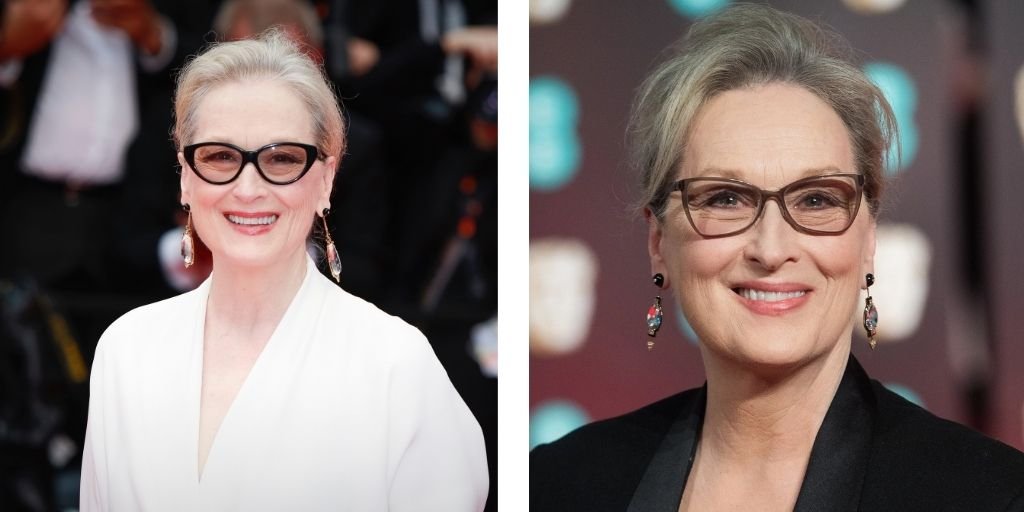
Meryl Streep is one of the most recognizable names in modern cinema. For decades, audiences have watched her transform into journalists, mothers, artists, political figures, authors, musicians, and ordinary women facing extraordinary situations. What makes her career so fascinating is not simply the number of films she has appeared in, but the remarkable variety of characters she has brought to life.
Born Mary Louise Streep on June 22, 1949, in Summit, New Jersey, she developed an interest in performance before becoming one of Hollywood’s most celebrated actresses. Her career has moved comfortably between serious dramas, comedy, musicals, television, and stage work.
From Kramer vs. Kramer and Sophie’s Choice to The Devil Wears Prada, Mamma Mia!, Julie & Julia, and The Iron Lady, her filmography demonstrates an unusual ability to make very different characters feel believable. Her awards history reflects that longevity: the Academy notes three Oscar wins, while the Golden Globes database records eight wins and dozens of nominations across her career.
So, what is it about her work that has kept audiences interested for so many years? The answer can be found in the way she approaches every character as a complete person rather than simply a role.
Early Life and Education
Growing up in New Jersey
Meryl Streep was raised in New Jersey in a family that encouraged her interests. During her younger years, she developed an interest in singing and performing. Her path was not an overnight journey to Hollywood. Instead, she spent years developing her abilities through education and theatrical experience.
That foundation became important later because acting requires much more than memorizing lines. An actor has to understand emotion, timing, voice, movement, relationships, and the world surrounding a character.
Discovering the stage
Streep eventually studied drama at Vassar College and later continued her formal training at the Yale School of Drama. Theatre provided her with an environment where performance could be developed through repetition, discipline, and close collaboration.
Think of that training like learning to play an instrument. Talent may help someone begin, but practice teaches control. Streep’s education gave her an opportunity to develop the technical side of performance before becoming a major screen actress.
The Beginning of a Remarkable Acting Career
Early screen appearances
Streep began attracting attention during the 1970s. Her early work included theatre and television before she moved into important film roles.
One of her breakthrough performances came in The Deer Hunter in 1978. The film earned significant critical attention, and Streep received her first Academy Award nomination for her supporting performance. The Academy’s records list her among the nominees for Supporting Actress at the 1979 ceremony.
Her career was already moving quickly, but the following years would establish her as a major dramatic performer.
A turning point
The late 1970s and early 1980s were especially important. Kramer vs. Kramer gave her an opportunity to play a complicated family role, while The French Lieutenant’s Woman demonstrated her ability to handle a demanding period drama.
Rather than being associated with one particular type of character, she began developing a reputation for variety.
Kramer vs. Kramer and Her First Oscar
One of the defining moments of Streep’s early career came with Kramer vs. Kramer, released in 1979.
The film focuses on a marriage breaking apart and the effect of divorce on a family. Streep played Joanna Kramer, a mother whose decisions have significant consequences for both herself and her family.
The performance earned her the Academy Award for Best Supporting Actress. The Academy’s official records identify Streep as the winner in that category at the 52nd Academy Awards.
The significance of the performance goes beyond the award. Joanna was not presented as a simple hero or villain. She was a person dealing with difficult emotions and choices.
That complexity became a recurring feature of Streep’s career.
Sophie’s Choice and a Historic Performance
A role that became part of cinema history
In 1982, Streep starred in Sophie’s Choice, directed by Alan J. Pakula and based on William Styron’s novel.
She played Sophie, a Polish survivor of Nazi persecution who carries an extremely painful past. The character’s emotional history makes the film demanding, both for the performer and the audience.
Streep’s performance earned her the Academy Award for Best Actress. The Academy’s official ceremony record confirms that she won the category for Sophie’s Choice.
The Golden Globes also recognized the performance with a Best Actress win.
Why the performance mattered
The role showed how Streep could communicate emotion through small details rather than relying only on dramatic speeches.
A pause, a change in expression, a different rhythm of speaking, or a slight movement can tell an audience something about a character. Streep became particularly known for this type of detailed performance.
A Career Built on Variety
One of the easiest ways to understand Streep’s career is to look at the range of characters she has played.
She has portrayed:
- Historical figures
- Mothers
- Writers
- Businesswomen
- Journalists
- Musicians
- Political figures
- Teachers
- Romantic leads
- Comedic characters
- Fictional villains and difficult personalities
Her filmography includes Out of Africa, A Cry in the Dark, Postcards from the Edge, The Bridges of Madison County, The Hours, Doubt, and August: Osage County, among many others. The Golden Globes database lists these performances among her extensive award history.
This variety has allowed different generations to discover her through completely different movies.
Someone might know her from a serious historical drama, while another viewer might first encounter her through a musical or comedy.
The Devil Wears Prada and a New Generation of Fans
Miranda Priestly
In 2006, Streep appeared as Miranda Priestly in The Devil Wears Prada.
The character was very different from many of her earlier dramatic roles. Miranda is the powerful editor of a major fashion magazine, and her demanding personality creates much of the movie’s tension.
Streep’s performance became one of her most widely recognized popular-culture roles.
The movie also demonstrated something important about her career: she could take a character who might easily become one-dimensional and give that character personality, humor, authority, and vulnerability.
Her Golden Globe record shows that she won Best Actress in a Motion Picture – Musical or Comedy for the film.
Why audiences remember Miranda
Miranda’s controlled voice, facial expressions, clothing, and sharp delivery became instantly recognizable.
The character is almost like a perfectly controlled storm. She rarely needs to shout because her presence does much of the work.
That is one reason the performance continues to be discussed years after the movie’s release.
Mamma Mia!, Music and Comedy
Streep surprised some audiences by embracing musical comedy in Mamma Mia!.
Based on songs by ABBA, the movie gave her the opportunity to combine acting with singing and movement. She played Donna, an independent mother whose past relationships become important when her daughter prepares for marriage.
The film showed another side of Streep’s abilities.
Instead of the heavy emotional atmosphere found in Sophie’s Choice or Doubt, Mamma Mia! allowed her to be energetic, funny, romantic, and openly emotional.
Her willingness to move between genres is one of the most interesting parts of her career. She has never been limited to a single definition of what a serious actor should do.
Julie & Julia and the Art of Transformation
In Julie & Julia, Streep played famous chef and television personality Julia Child.
The role required her to capture Child’s distinctive voice, physical mannerisms, enthusiasm, and personality.
The result earned Streep another Golden Globe victory. The Golden Globes database records her 2010 win for Best Performance by an Actress in a Motion Picture – Musical or Comedy for Julie & Julia.
More than an imitation
Playing a real person creates a unique challenge. The performer has to resemble the person without turning the role into an imitation.
Streep’s performance focused on personality as much as appearance. Julia Child comes across as energetic, curious, warm, and passionate about food.
That approach helped make the character accessible even to viewers who were unfamiliar with Child’s television career.
The Iron Lady and Margaret Thatcher
Another major transformation came with The Iron Lady, where Streep portrayed British political leader Margaret Thatcher.
The film explores Thatcher’s life and political career through a dramatic portrait that moves between different periods of her life.
Streep received the Academy Award for Best Actress for the performance. The Academy confirms her win at the 84th Academy Awards for the role.
The Golden Globes also recognized her performance with a Best Actress award in the drama category.
The role again demonstrated her approach to physical and vocal transformation. Rather than simply reproducing the public image of Thatcher, the performance explored an individual moving through different stages of life.
Later Career and Television Success
Expanding beyond cinema
Streep’s career has not been limited to feature films. She has also taken important television roles.
Her appearance in Big Little Lies introduced her to another generation of television viewers. She played Mary Louise Wright, a character whose arrival changes the dynamics of the story.
The Golden Globes record lists her as a 2020 nominee for the role.
She later joined Only Murders in the Building, bringing her experience to a television comedy and mystery setting. She received a Golden Globe nomination for the role in 2024.
This movement between film and television reflects a larger change in entertainment. Major performers can now build important work across theaters, streaming services, and television rather than staying within one format.
Awards and Recognition
Streep’s awards history is unusually extensive.
The Golden Globes database currently lists 33 nominations and 8 wins for her.
Her Academy Award history includes wins for:
- Kramer vs. Kramer — Supporting Actress
- Sophie’s Choice — Actress
- The Iron Lady — Actress
The Academy also recorded her 19th acting nomination for Into the Woods in 2015.
Awards alone, however, do not completely explain her cultural impact.
An award is a snapshot of recognition at one particular moment. A career lasting decades is something different. Streep’s longevity comes from continually finding new characters and new challenges.
Acting Style and Why Her Performances Stand Out
Attention to detail
Streep is widely associated with careful preparation and character transformation.
Her performances often involve changes in accent, posture, voice, facial expression, and physical movement. These details may seem small individually, but together they create a convincing character.
Emotional intelligence
Another important element is emotional complexity.
Her characters are rarely completely good or completely bad. They may make mistakes, hide emotions, change their minds, or behave differently depending on who is around them.
That makes them feel more like real people.
The power of voice
Voice is also central to her work.
A character’s voice can communicate age, background, confidence, fear, authority, or uncertainty. Streep has repeatedly used vocal changes as part of her transformations.
Her approach can be compared to changing the settings on a camera. The person remains the same performer, but the audience sees an entirely different picture.
Meryl Streep’s Cultural Legacy
Streep’s influence extends beyond individual films.
For aspiring actors, her career demonstrates the value of versatility. She has shown that an actress does not have to remain in one genre or repeat one successful formula.
Her work also illustrates the possibilities available to performers as they age. Instead of treating acting as a career with a short expiration date, she has continued to take substantial roles across multiple decades.
Her career has therefore become part of a broader conversation about women, aging, representation, and opportunity in entertainment.
At the same time, audiences continue to connect with her because her performances remain rooted in recognizable human experiences: love, family, ambition, regret, humor, loss, friendship, and change.
Conclusion: Why Meryl Streep Remains a Major Figure in Cinema
Meryl Streep’s career is remarkable because it combines longevity with variety. From her early breakthrough in The Deer Hunter to Oscar-winning performances in Kramer vs. Kramer, Sophie’s Choice, and The Iron Lady, she has repeatedly entered completely different worlds and made them believable.
She has also shown that serious acting and popular entertainment do not have to be separate. The Devil Wears Prada, Mamma Mia!, and Julie & Julia allowed millions of viewers to enjoy a lighter side of her work, while films such as Doubt, The Hours, and The Post offered more dramatic material.
Perhaps that is the simplest way to understand her lasting appeal. Like a skilled musician who can move between completely different pieces without losing control of the instrument, Streep has repeatedly changed characters while maintaining the emotional detail that makes her performances memorable.
Her legacy is not based on one movie or one award. It is the result of decades of work, experimentation, and an extraordinary range of characters.
Frequently Asked Questions
1. Who is Meryl Streep?
Meryl Streep is an American actress known for her extensive career in film, television, and theatre. She has appeared in dramas, comedies, musicals, historical films, and character-driven stories.
2. How many Oscars has Meryl Streep won?
Meryl Streep has won three Academy Awards: Supporting Actress for Kramer vs. Kramer, Best Actress for Sophie’s Choice, and Best Actress for The Iron Lady.
3. What are some of Meryl Streep’s most famous movies?
Some of her best-known films include Kramer vs. Kramer, Sophie’s Choice, Out of Africa, The Devil Wears Prada, Mamma Mia!, Julie & Julia, Doubt, The Iron Lady, and The Post.
4. Has Meryl Streep appeared on television?
Yes. She has appeared in television productions including Big Little Lies and Only Murders in the Building, receiving Golden Globe recognition for both.
5. Why is Meryl Streep considered an influential actress?
Her long career, broad range of characters, detailed performances, and ability to work across drama, comedy, musicals, film, and television have made her a significant figure in m
